

Resting the Spot
Aug 25, 2026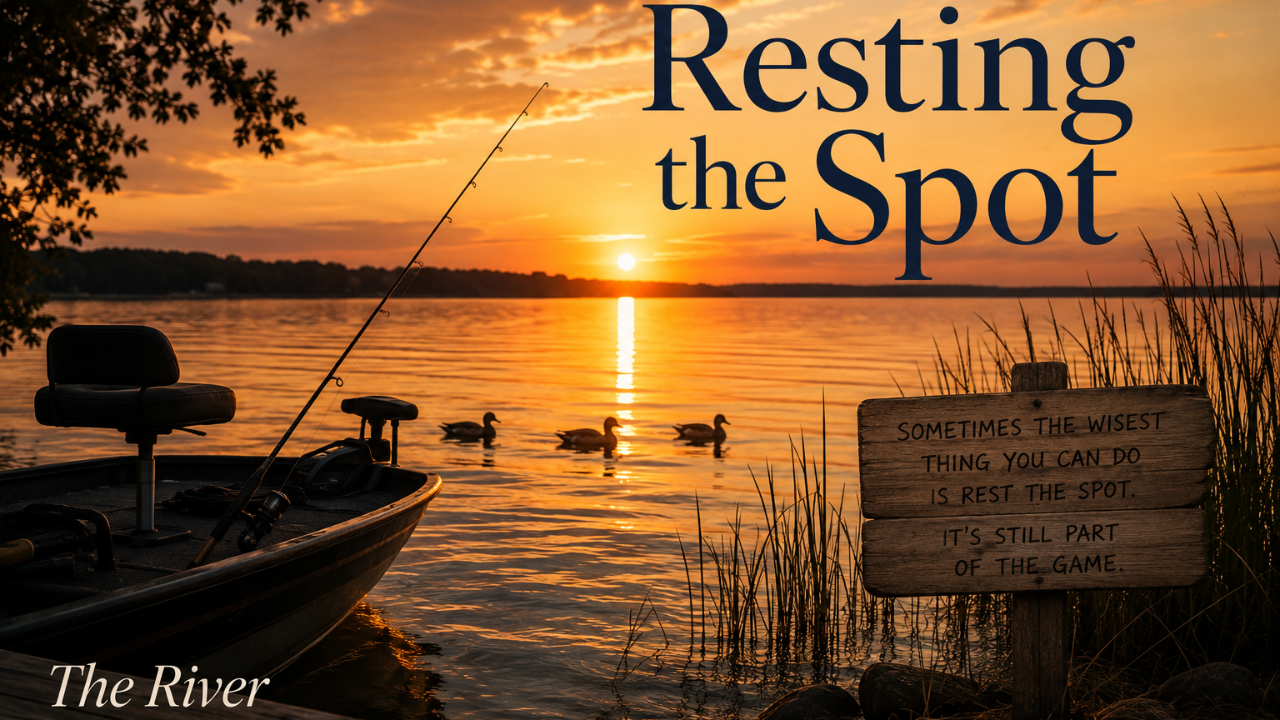
There is a debate among fishermen that I've always found interesting.
Suppose you've found a great spot and the fish are biting. You've caught several, but eventually the action begins to slow. So you pull up the trolling motor, move away and give the spot a rest.. Maybe you eat lunch, try somewhere else or simply drift for a while before returning.
Here's the question: While you're resting the spot, are you still fishing?
Some would say no. If your line isn't in the water, you're not fishing. I disagree.
Resting the spot is part of fishing.
Experience teaches us that continuing to pound the same fish can eventually make them wary or shut the bite down completely. Sometimes the best thing you can do to catch another fish is to stop trying to catch one.
To me the same principle applies to our lives.
We live in a culture that celebrates motion. Answer another email. Schedule another meeting. Make another call. Finish another project. Check another box.
Doing something feels productive. Doing nothing does not.
But researchers studying how humans recover from work have discovered that stopping may be far more productive than we think.
Sabine Sonnentag of the University of Mannheim has spent decades studying what psychologists call psychological detachment. It’s our ability to mentally disconnect from work when we aren't working. Her research has found that people who successfully detach from work during their off-hours tend to experience better moods, less fatigue and greater life satisfaction. Importantly, they aren't necessarily less engaged when they return to work.
Recovery isn't the enemy of performance. It is part of performance.
There is a crazy aspect to this that we should all recognize in our lives. The periods when we most need to recover can be the very times when recovery becomes hardest. High workloads and stressful days make it more difficult for us to mentally disconnect from work.
It is, by far, one of the most challenges aspects of my 35-year professional career with Deere & Company. At times, I was never able to unplug at night or on weekends. Maybe you know the feeling as well.
The big presentation is tomorrow. The business is struggling. Something is wrong at work. We wake up at 2:00 a.m. thinking about it. We carry it to dinner. We check our phone during a conversation with someone we love.
Our body may have left work, but our mind never did.
Stopping doesn't necessarily mean sitting on the couch doing nothing. It might mean taking a walk, exercising, fishing, working in the garden, listening to music, having dinner with someone we love or simply putting the phone somewhere we cannot reach it.
The important part is giving our minds permission to “rest the spot”.
Interestingly, there is evidence that stepping away can even help with difficult problems. Research on creative “incubation” suggests that temporarily setting aside a problem can improve later creative performance. Our minds continue making connections precisely because we've stopped forcing the answer.
That's a lesson leaders should remember as well.
We sometimes celebrate the executive who works every weekend, responds to emails at midnight and never really goes on vacation. Perhaps we should be equally impressed by the leader who knows when to stop, and gives everyone around them permission to do the same.
Rest isn't something we earn after all the work is finished. The work is never finished. Rest is something we deliberately build into a life that we want to sustain.
Which brings me back to fishing.
When I pull away from a productive spot and let it rest, I don't consider that time wasted. I'm making a deliberate decision that I believe improves what happens when I return.
Think about the impact of this on your life in the same way. Where in your life do you need to stop pushing and let the spot rest? Can you truly disconnect without feeling guilty about it? And what if occasionally doing nothing isn't time away from living a productive life, but an essential part of one?
Tony Thelen is the founder of The River Coaching and Consulting, LLC, an executive coaching firm based in West Okoboji. He is the author of "Am I Doing This Right?" and "Things We Desire." He works with CEOs, business owners, and executives to remove pain, anxiety, and stress while making room for true personal and professional growth. Contact Tony at [email protected] or learn more at www.therivercoach.org
Author
