

Different Perspectives. Better Decisions. Better Life.
Aug 11, 2026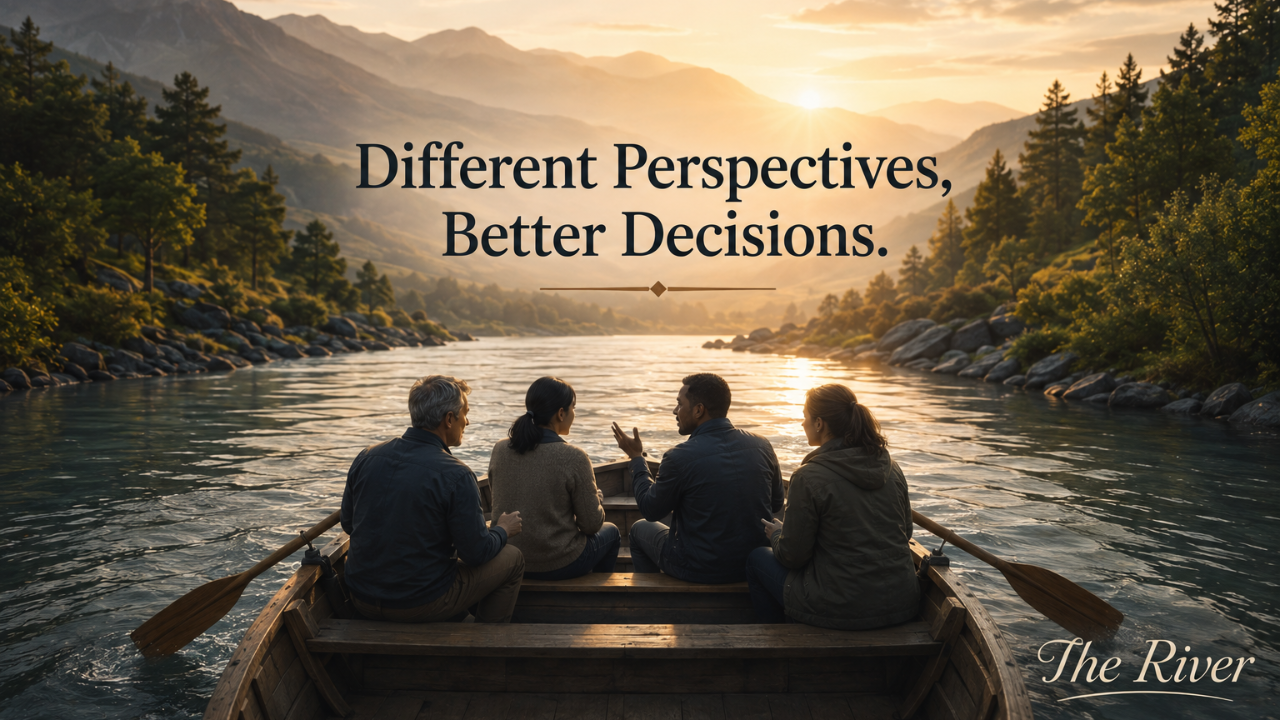
In 2021, I attended a seminar hosted by the Santa Fe Institute in New Mexico, a world-renowned think tank dedicated to understanding complexity. The audience reflected that mission. Scientists, business leaders, psychologists, economists, theologians, and academics gathered to wrestle with one central question: How do we solve the world's most complex problems?
I had a practical reason for attending. At the time, I was leading an organization of 2500 employees through three challenges: navigating COVID-19, accelerating a major digital transformation, and expanding globally. Dealing with complexity was my daily reality.
While there, I met Professor Scott Page from the University of Michigan, whose research focuses on complex systems and decision-making. During our conversation, I asked him a simple question. "If there is one thing from your research that I could take back to my organization, what would it be?" He had a pretty good answer to this question, and it changed my thinking, and how I built teams at work.
He explained that his research uncovered what he calls The Diversity Bonus.
Teams made up of people with similar experiences, similar perspectives, and similar ways of thinking often make decisions quickly. Meetings feel efficient. Consensus comes easily. People leave feeling good about the process. The problem? Those decisions are often not the best.
By contrast, teams composed of people with genuinely different backgrounds, experiences, expertise, and mental models tend to have far more disagreement. They challenge assumptions. They ask uncomfortable questions. They argue over priorities and debate competing ideas. The meetings are slower. The conversations are harder. People often leave feeling emotionally exhausted.
Yet, over and over again, the research demonstrates that these teams produce better decisions. Not occasionally. Consistently.
Across industries, across cultures, and across different team sizes, diverse teams outperform homogeneous ones when solving complex problems because they simply see more of the problem. Each person sees the problem in a different lens, revealing blind spots others can’t possibly see.
That realization changed how I thought about leadership.
Many leaders instinctively try to eliminate conflict. I was mistaking harmony for health. I assumed a meeting that ends quickly with unanimous agreement was a productive one. Maybe sometimes it was, but sometimes it was simply evidence that everyone viewed the world through the same window.
Great leaders don't create unnecessary conflict. They create environments where respectful disagreement is welcomed because the goal isn't winning an argument. It's finding the best answer.
Healthy teams learn to argue fiercely for their ideas while remaining deeply committed to one another. Once the decision is made, everyone rows in the same direction. That is the environment I became committed to ever since. It required psychological safety, humility, curiosity, and trust. It also requires leaders who are comfortable hearing perspectives that challenge their own, which takes a special kind of courage.
So, how diverse is your own thinking?
Do you intentionally seek out people who challenge your assumptions, or do you naturally surround yourself with those who reinforce what you already believe?
Our closest friends often share our values, which is a wonderful thing. But if every conversation confirms what we already think, our own growth may become limited. Reading authors with different perspectives, listening before defending, and remaining curious instead of certain may improve not only our decisions, but our understanding of the world.
Perhaps wisdom isn't found in eliminating differences, but in learning how to leverage our differences.
A few thoughts to consider:
- Does your team encourage healthy disagreement, or quiet agreement?
- When was the last time someone changed your mind because you genuinely listened?
- Do you hire people who think differently than you, or people who make meetings easier?
- In your personal life, who challenges your assumptions in ways that make you better?
- How do you reach out for differing perspectives about the world?
Tony Thelen is the founder of The River Coaching and Consulting, LLC, an executive coaching firm based in West Okoboji. He is the author of "Am I Doing This Right?" and "Things We Desire." He works with CEOs, business owners, and executives to remove pain, anxiety, and stress while making room for true personal and professional growth. Contact Tony at [email protected] or learn more at www.therivercoach.org
Author
